





A Word That Doesn’t Show Up in Most English Farming Guides
If you’ve landed here after typing “Messeregge” into a search bar, you’ve probably noticed something odd: the term barely exists in English-language agricultural writing. Ask five German-speaking farmers what it means and you’ll likely get five slightly different answers, depending on region, dealer, and which brand’s catalog they read last.
That’s worth saying up front, because a lot of what’s floating around online about this word is guesswork dressed up as certainty. So let’s do this properly — starting with the part that’s actually solid: the language itself.
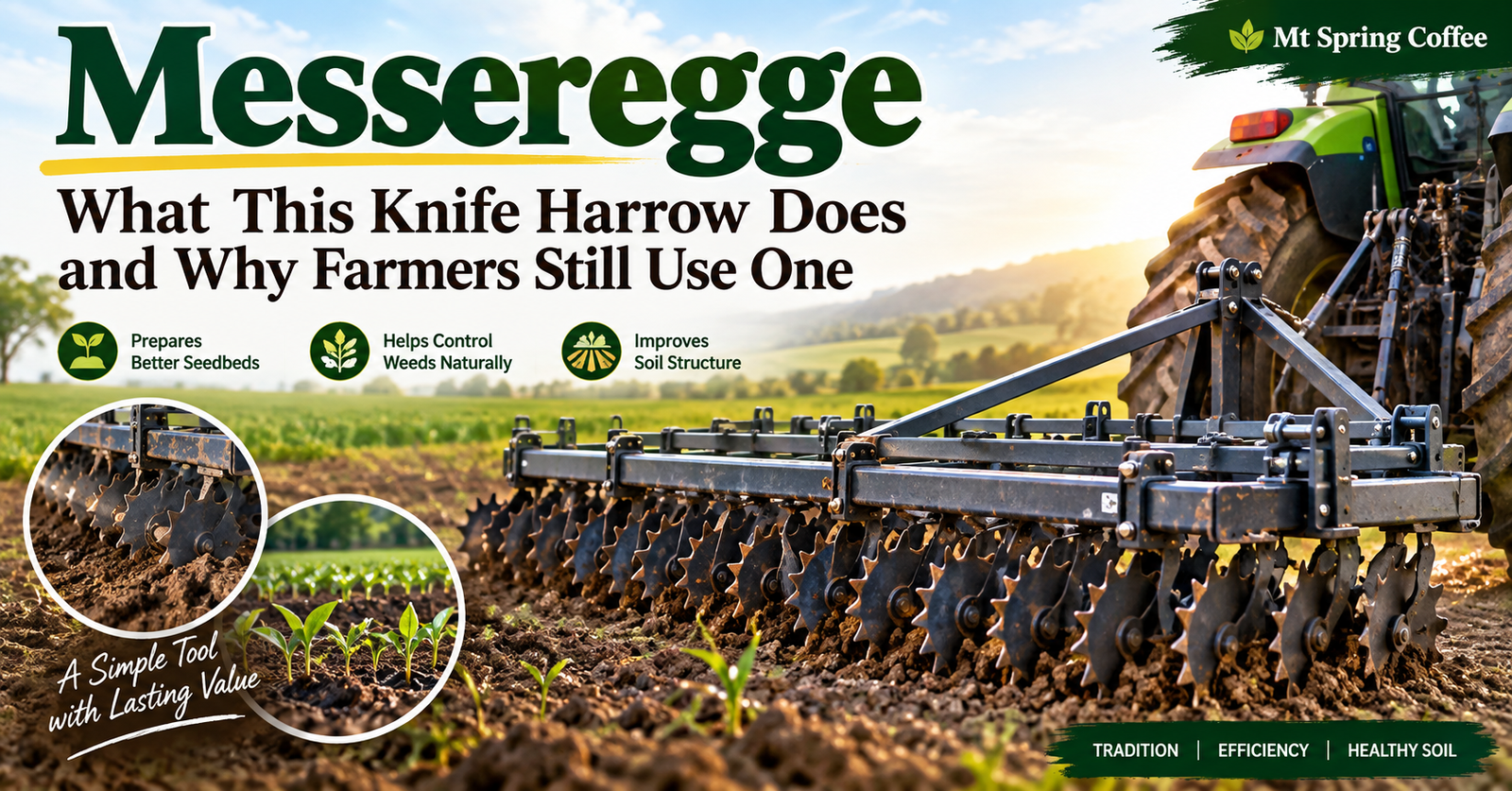
Messer is German for knife or blade. Egge is German for harrow — a tined or bladed implement dragged or mounted to break up and level soil. Put them together and you get a compound noun doing exactly what German compound nouns do: describing a tool by what it’s made of and what it does. A Messeregge, in plain terms, is a knife harrow — a harrow fitted with flat, blade-shaped tines instead of the curved spikes you’d see on a standard spring-tine harrow.
That’s the definition with actual linguistic footing. Everything else — claims about it being a knife’s cutting edge, a trade-show booth frame, or some kind of cultural region — doesn’t hold up against how the word is actually built or where it turns up in machinery literature. This article sticks to the tillage-tool meaning, because that’s the one you can verify just by breaking the word apart.
What a Knife Harrow Actually Does in the Field
Picture a field after plowing or deep cultivation. The surface is uneven, there are clods of compacted soil scattered across it, and if you drilled seed straight into that mess, germination would be patchy at best. Something has to go over that ground first and knock it into shape.
That’s the job of a knife harrow. Instead of stirring soil deeply the way a cultivator does, it works close to the surface:
- Slices through clods rather than dragging them along, which reduces smearing in heavier or wetter soils
- Levels the top few centimeters so a following implement — a roller, a seed drill, a packer — has an even surface to work
- Leaves fine soil on top and larger material below, which is exactly the layering you want for consistent seed depth
Farmers rarely run a knife harrow on its own. It’s almost always paired with something else, because seedbed prep is a multi-step job and this tool handles one specific part of it.
Where It Sits in the Tillage Chain
Think of seedbed preparation as an assembly line, not a single pass. A typical sequence might look like this:
- Primary tillage — plowing or deep loosening breaks up the field at depth
- Front-mounted knife harrow (Messeregge) — breaks clods and levels the surface ahead of the tractor
- Packer or roller — firms the soil and closes air pockets so moisture can move up to the seed
- Seed drill — places seed at a consistent, shallow depth into that prepared surface
Mounting the knife harrow on the front of the tractor while a packer or drill runs on the rear means one tractor pass does the work that might otherwise take two or three trips across the field. That matters more than it sounds like it should — every extra pass compacts soil, burns fuel, and eats into a planting window that’s often only a few good days wide.
Why Front-Mounting Makes Sense
There’s a practical logic to putting the blade harrow at the front rather than dragging it behind everything else:
- The front tool breaks the roughest material first, so whatever’s mounted behind it (a packer, roller, or drill) meets softer, more even ground
- It lets the operator see the working width directly ahead, which helps with keeping the pass straight on irregular field edges
- Combining front and rear implements cuts the number of passes, which is one of the more direct ways to reduce both fuel use and soil compaction on a given field
Knife Harrow vs. Spring-Tine Harrow vs. Disc Harrow
People searching for a knife harrow are often trying to figure out whether it’s actually the right tool, or whether something else in the shed would do the job better. Here’s how the three most commonly confused options compare.
| Feature | Knife Harrow (Messeregge) | Spring-Tine Harrow | Disc Harrow |
|---|---|---|---|
| Working action | Slices and levels near the surface | Vibrates and stirs loose soil | Cuts and turns soil in rows |
| Best soil condition | Cloddy, uneven ground after primary tillage | Already loose, fine soil | Heavier residue or sod |
| Typical mounting | Front of tractor | Front or rear | Rear, often trailed |
| Working depth | Shallow (surface-level) | Shallow to moderate | Moderate to deep |
| Common pairing | Front packer, roller, or drill | Seed drill, cultivator | Plow, subsoiler |
| Main strength | Clod-breaking without deep disturbance | Fine seedbed finishing | Residue incorporation |
None of these tools replaces the others outright — they’re suited to different soil states, and a lot of real-world tillage plans use two or more of them in sequence rather than picking just one.
Who Actually Uses This, and Why It’s Not More Widely Known
Blade harrows like this are common in continental European arable farming, particularly in Germany, Austria, and parts of the Benelux region, where front-mounted combination tillage is a well-established practice. They show up most often as an add-on option to front packer systems rather than as a standalone product line — which is a big part of why the term rarely surfaces in English-language equipment catalogs. English-speaking markets tend to describe the same function with more generic phrasing: “front clod-crushing bar,” “front leveling harrow,” or simply “front tillage attachment.”
That naming gap is exactly why the word “Messeregge” confuses people who encounter it outside a German-language context. It’s not an obscure or invented concept — it’s a normal piece of regional trade vocabulary that hasn’t been consistently translated.
Choosing the Right Setup for Your Field
If you’re weighing whether a knife harrow attachment makes sense for your operation, a few questions are worth sitting with before you buy:
- How cloddy is your ground after primary tillage? Heavy clay that dries into hard lumps benefits far more from a blade harrow than sandy loam that’s already fairly loose.
- What’s mounted on the back of your tractor already? A front knife harrow earns its keep when it’s paired with a rear packer or drill — on its own, it’s a partial solution.
- How tight is your planting window? If you’re combining multiple soil jobs into fewer passes to hit a narrow window, a front-mounted tool like this is where that time savings actually comes from.
- What’s your working width elsewhere in the setup? A front attachment needs to roughly match the width of whatever’s doing the finishing work behind it, or you’ll get uneven results at the edges of each pass.
There’s no universal answer here — soil type, climate, and rotation all push the decision in different directions. But those four questions cover most of what separates “this tool is worth the investment” from “this is solving a problem I don’t have.”
Common Mistakes When Using a Knife Harrow
A few issues come up repeatedly with this type of implement, and most of them are avoidable:
- Running it too deep. A knife harrow is a surface tool. Set too aggressively, it starts behaving like a cultivator and loses the fine, even finish it’s meant to produce.
- Ignoring height adjustment across the width. Many models use spindle-adjusted height settings so the blades stay level across an uneven field surface. Skipping that calibration leads to inconsistent clod-breaking from one side of the pass to the other.
- Pairing it with the wrong rear implement. A knife harrow feeding into a poorly matched packer or drill just moves the unevenness further down the line instead of solving it.
- Treating it as a stand-alone finishing tool. It prepares ground for the next step — it isn’t usually meant to produce a finished seedbed by itself.
Frequently Asked Questions
What does Messeregge mean in English?
It translates roughly to “knife harrow” — a farm implement with blade-shaped working parts used to break soil clods and level the surface ahead of planting.
Is a Messeregge the same as a regular harrow?
Not exactly. A standard spring-tine harrow uses curved spike-like tines to stir and loosen soil. A knife harrow uses flatter, blade-shaped tines designed more for slicing and leveling than deep stirring.
Where is a Messeregge usually mounted on a tractor?
Most commonly on the front, paired with a rear-mounted packer, roller, or seed drill so multiple soil-preparation steps happen in a single pass.
What soil types benefit most from a knife harrow?
Heavier soils that dry into hard clods after tillage tend to see the biggest benefit, since the blade action breaks that material up without over-working the ground.
Can a Messeregge replace a plow or cultivator?
No. It works at shallow depth and is meant to follow primary tillage, not replace it. It’s a finishing and leveling tool, not a deep-tillage implement.
Why isn’t “Messeregge” a common term in English farming resources?
It’s regional trade vocabulary from German-speaking farming markets. English-language equipment descriptions usually use more generic phrasing for the same function, so the specific German term rarely gets carried over in translation.
Read More: Provascin Explained: Ingredients, Evidence, Safety and Availability


One thought on “Messeregge: What This Knife Harrow Does and Why Farmers Still Use One”