







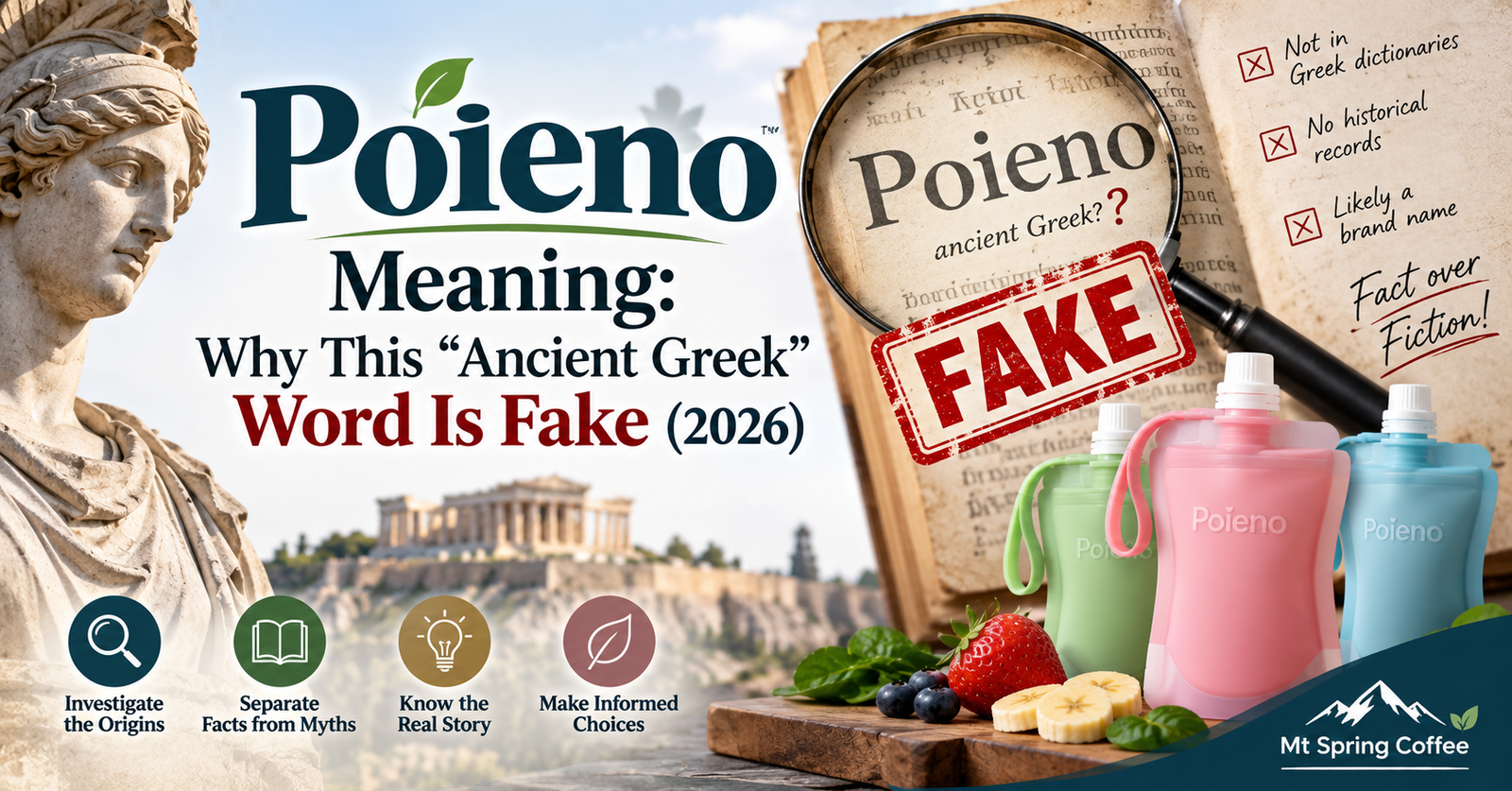
If you searched “Poieno meaning” and landed here, you’ve probably already read three or four articles telling you it’s an ancient Greek concept about “purposeful creation.” Maybe one even mentioned Aristotle. Maybe another claimed there are “Poieno families” with roots in Brazil and Italy.
None of that is true. Poieno isn’t a Greek word. It isn’t in any dictionary, in any language, anywhere. And the fact that it looks real — that it has a plausible-sounding etymology and a tidy philosophical backstory — is exactly what makes it worth picking apart.
This isn’t a rehash of those explainer posts. It’s the opposite of one: a look at what happens when a search engine optimization trick outpaces basic fact-checking, and how you can spot it happening again next time.
What People Are Actually Searching For
The search intent behind “Poieno” splits into a few clear buckets:
- People who saw the word somewhere (a listicle, a social post, an AI chatbot output) and want a definition
- People checking whether it’s a legitimate philosophical or psychological term
- People researching whether “Poieno” is a surname or family name
- Writers and researchers trying to verify a source before citing it
Nearly every existing result serves the first group by inventing an answer, and fails the other three completely. That’s the gap this article closes.
Where the Word Actually Came From
Here’s what’s verifiable.
Poiein (ποιεῖν) is a real, well-documented Ancient Greek verb meaning “to make” or “to do.” It’s the root of the English word “poet” — literally, “one who makes.” Aristotle really did draw a distinction between poiesis (making something, with an external result) and praxis (acting for its own sake, where the action itself is the point). You’ll find this in the Nicomachean Ethics and in Aristotle’s writing on tragedy and rhetoric. Poiesis itself is a live term today — it shows up in philosophy, in literary theory, and in biology through the concept of autopoiesis (a system that maintains and produces itself, a term coined by biologists Humberto Maturana and Francisco Varela in the 1970s).
Separately, poiană is a real Romanian word meaning “meadow” or “forest clearing,” with genuine diminutive forms like poieniță.
Both roots are documented, both are unrelated to each other, and neither one has ever produced a word spelled “Poieno” in any historical text, dictionary, or academic source. There’s no manuscript trail. No citation. No linguist tracing the derivation. The word simply doesn’t exist as a natural descendant of either root — it was assembled to sound like it might be.
How a Fake Word Gets a Fake History
This is the part worth understanding, because it’s a pattern, not a one-off.
- Start with something real. In this case, poiesis — a genuinely rich, citable concept with real academic weight behind it.
- Coin a plausible variant. “Poieno” reads like it could be Greek. It has the right shape, the right ending, the right vowel pattern.
- Publish a confident definition. The first site to define a term often becomes the source everyone else treats as ground truth, especially when there’s no competing definition to check it against.
- Let aggregation do the rest. Once three or four sites have “explained” a term the same way, it starts to look corroborated — even though every one of them is citing the same absence of evidence, just dressed up differently.
Search behavior researchers and outlets covering AI content farms have documented this exact mechanic at scale. NewsGuard’s tracking work identified over a hundred branded sites running largely on AI-generated output with minimal editorial oversight, and separate reporting has traced cases where AI-written sites pushed entirely fabricated stories into search and recommendation systems, from fake pyramid discoveries to invented government policies. Poieno is a small, low-stakes version of the same production line — invented content, brand names, and now, apparently, invented vocabulary.
The giveaway in Poieno’s case isn’t grammar or spelling. It’s structural: every article describes the concept in almost identical terms (“turning ideas into reality,” “purposeful creation,” “not yet an official dictionary word, but—”) while none can point to a single primary source. That “but” is doing a lot of work. It’s the hedge that lets a site claim legitimacy and disclaim it in the same sentence.
Poieno vs. Real Greek-Derived Concepts
| Term | Documented? | Source | Actual Meaning |
|---|---|---|---|
| Poiesis | Yes | Aristotle, classical Greek texts, modern philosophy | The process of bringing something into existence |
| Autopoiesis | Yes | Maturana & Varela, 1972 | A system that produces and maintains itself |
| Poiein | Yes | Classical Greek, root of “poet” | To make, to do, to produce |
| Poiană | Yes | Romanian dictionaries | A meadow or forest clearing |
| Poieno | No | None found | Undefined; used only in recent SEO content |
Why This Matters Beyond One Word
If you’re a content creator, researcher, or just someone who fact-checks before repeating something, the Poieno pattern is a useful case study for three reasons.
It shows how thin “authority” can be online. A term appearing on five different websites feels like consensus. It isn’t, if all five are working from the same unverified starting point rather than independent sources.
It shows how AI-assisted publishing can outrun editorial standards. None of this requires malice. A writer (human or AI) makes a plausible-sounding claim, it gets picked up, and momentum does the rest. The Reuters Institute’s research on AI content has flagged this exact dynamic — content optimized for engagement and search visibility, with accuracy as an afterthought.
It’s a good practical filter for the next “trending word” you see. Before treating a term as established:
- Search for it in a real dictionary (Merriam-Webster, Oxford, or a language-specific one like Logeion for Greek)
- Check whether any source predates the last 12–18 months
- Look for a named author with real credentials, not a generic byline
- See whether independent academic or journalistic sources reference it — not just other content sites
If You Came Here Because You Want a Word for “Purposeful Creation”
There’s good news: real language already has you covered, and using an actual documented term will hold up better in writing, research, or branding than one with no paper trail.
- Poiesis — the philosophical term for bringing something new into being, especially through creative or intentional action
- Praxis — action or practice, particularly action guided by theory or values
- Ergon — Greek for “work” or “function,” used by Aristotle to describe the characteristic activity of a thing
- Genesis — from Greek genesis, “origin” or “coming into being”
- Autopoiesis — for a system, organization, or process that sustains and regenerates itself
Any of these carries real etymological weight if you’re writing, naming a project, or building a brand around the idea of intentional creation.
Frequently Asked Questions
Is Poieno a real word?
No. It doesn’t appear in any English, Greek, or Romanian dictionary, and no linguistic source documents it as a genuine derivative of any language.
Where did Poieno come from?
It appears to have originated in recent SEO content that borrowed the sound and general idea of the real Greek word poiein (“to make”) without an actual documented connection.
Is Poieno connected to ancient Greek philosophy?
Only loosely, and not in the way most articles claim. The real Greek concept it echoes, poiesis, is legitimate and well-documented — but “Poieno” itself is not a historical form of that word.
Are there real families with the surname Poieno?
No genealogical, census, or historical record supports the existence of “Poieno” as a surname or family name. Claims of this kind appear to be invented.
What should I use instead if I want a word with real meaning?
Poiesis, praxis, or autopoiesis are documented terms that capture similar ideas about purposeful creation and are safe to cite or reference.
Why do multiple websites define Poieno the same way if it isn’t real?
Because they’re very likely drawing from each other rather than from independent, verifiable sources — a common pattern in fast-turnaround, AI-assisted content production.
Read More: Reusable Silicone Smoothiepussit: The Complete Buyer’s Guide (2026)



One thought on “Poieno Meaning: Why This “Ancient Greek” Word Is Fake (2026)”